
Introduction ADAM
.png)
Yuval Peled

Yuval Peled
Leading AI infrastructure, scalable systems, and LLM engineering, driving technical excellence behind Notch autonomous customer support agents and the Notch OS platform.
Subscribe to updates
Receive the latest content and invites to your inbox, unsubscribe anytime.


ADAM Is Not a Co-Pilot. It's the Operating Layer for AI Work.
Some co-pilots assist humans inside one interface (most AI tools answer questions). Very few actually understand the business, operate across systems, and get better over time.
That distinction sounds subtle. It is not.
In regulated industries like insurance and financial services, the difference between "AI that helps" and "AI that operates" is the difference between a suggestion box and an engine room. Co-pilots sit next to the workflow, offering recommendations that someone still has to act on. They are useful. They are also fundamentally limited by the same constraint: a human has to be in the loop for every action, every decision, every follow-through.
What if the system could do more than advise? What if it could understand the business context, take action within governed boundaries, learn from outcomes, and improve the operation continuously - not as a replacement for the team, but as a co-worker that handles the operational load so the team can focus on judgment, strategy, and the cases that actually need human expertise?
That is what ADAM is built to do, you Claude Code for insurance:
So What Is ADAM?
ADAM - AI Dialogue and Automation Mindframe - is the operating architecture behind how AI work gets done across the Notch OS platform. It is not a co-pilot with better memory. It is not a dashboard with natural language search. It is the system-level layer that sits above your agents, your data, your workflows, and your business logic - coordinating how work gets done across the entire operation.
Think of ADAM as the manager of all your AI agents. Every Notch deployment runs specialized agents for different workflows: one handles policyholder calls, another processes documents, another runs claims intake, another triages email. Each of those agents is good at its job. But without coordination, they create the same problem that human teams face without good management - fragmentation, inconsistency, and information that gets stuck in silos.
That zoom-in, zoom-out capability is what makes ADAM different from every other AI system on the market. An assistant can handle one interaction. A dashboard can show aggregate metrics. ADAM does both simultaneously, and it uses the connection between them to make the entire operation better.
ADAM works continuously across Notch’s conversational agents, internal copilots, and back-office automations as an evaluator and continuous improvement engine.
It operates through a simple three-step cycle:
Explore and Analyze
ADAM reviews real operational interactions, including claims escalations, support conversations, employee questions, and back-office workflows, to identify recurring issues, friction points, and bottlenecks.
Provide Feedback
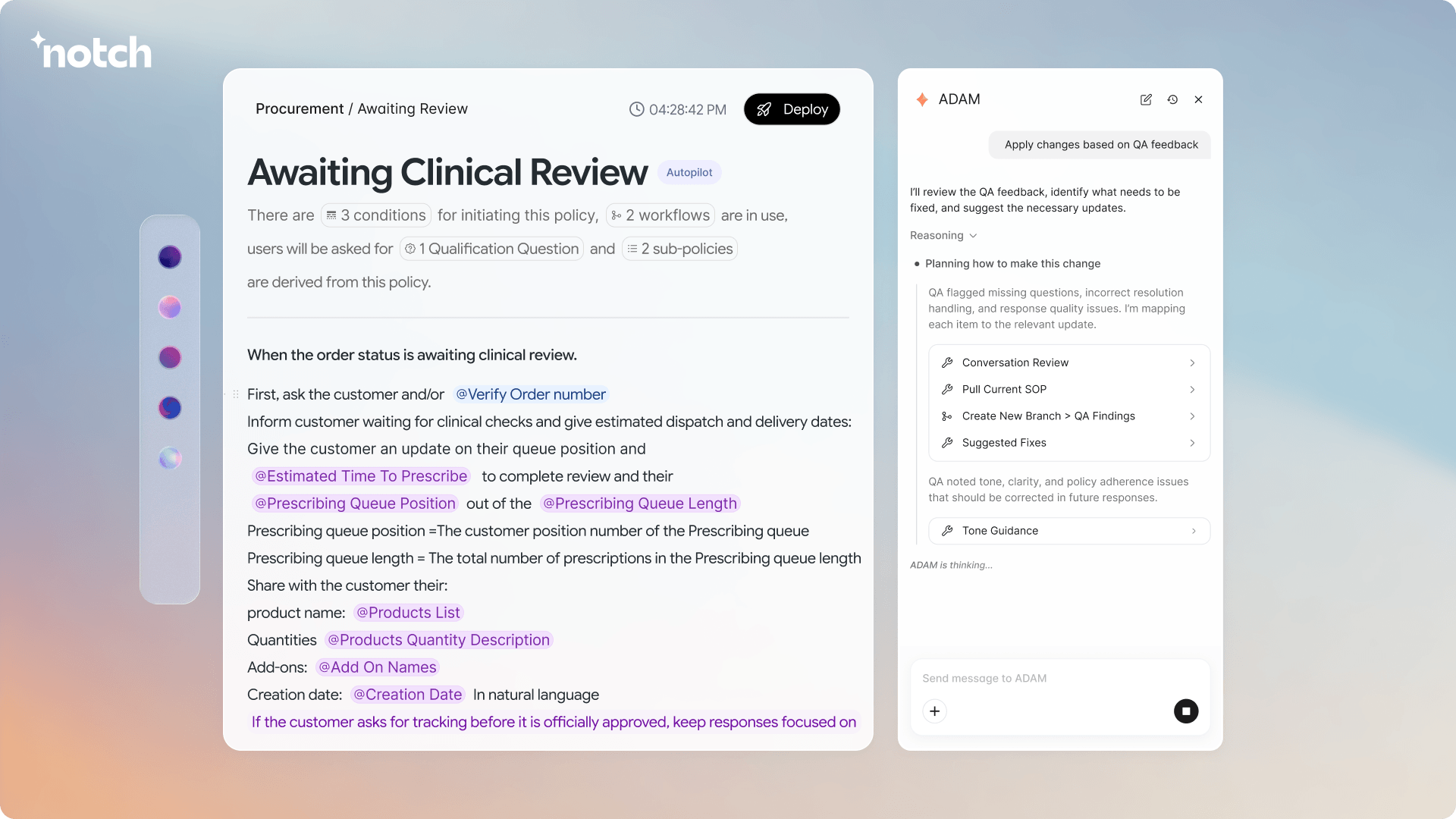
ADAM evaluates the processes behind those interactions, surfacing outdated SOPs, policy gaps, compliance blind spots, and workflow breakdowns that create delays or drive escalations.
Build and Fix
ADAM recommends improvements to the underlying logic, policies, and workflows, then helps your team turn those recommendations into working solutions. That might mean updating a policy, refining an existing automation, or deploying a new AI agent to address a costly operational bottleneck, with your team fully in control of what ships.
What makes ADAM different is its ability to understand the enterprise at both the micro and macro levels. It can zoom out to see how a front-end customer conversation affects a back-office claims process, and zoom in on a single interaction to identify exactly what went wrong.
This intelligence is accessible directly inside the Notch platform. Teams can open a side chat and ask plain-language questions about the business, such as, “Which claim types are slowing us down?” ADAM turns those questions into operational insight, then helps teams act on what it finds.
ADAM, your new co-worker who is always on, is the intelligence that understands both the details and the big picture, and adapts the whole system based on what it learns from each signal.
The Architecture: How We Built ADAM as a Co-Worker
We built ADAM to function less like an assistant sitting beside the workflow and more like a co-worker embedded inside the operation itself. Its job is not just to respond in the moment, but to understand how work is done, improve how that work is defined, and help the organization continuously get better at running it. That ability comes from five architectural primitives working together.
Brain: the ability to analyze, understand, and improve.
The Brain is what allows ADAM to move beyond answering and into operational thinking. It analyzes conversations, workflows, outcomes, and edge cases to understand not only what happened, but what should change as a result. When a recurring issue appears, ADAM can identify whether the problem lives in the prompt, the SOP, the workflow design, the captured data, or the business rule itself. It does not stop at insight. It helps define the next version of the system.
Hands: the ability to build and update the system itself.
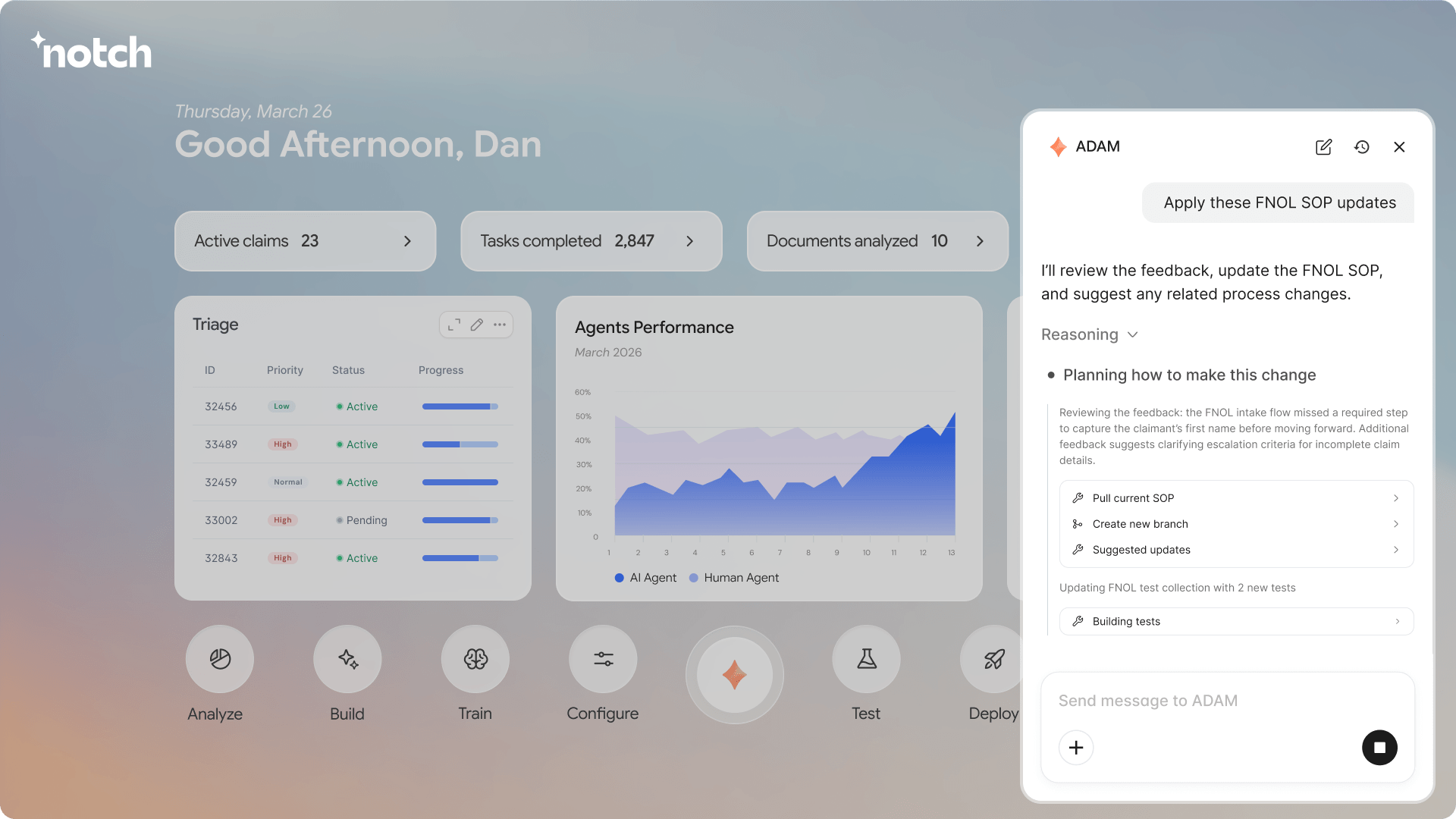
ADAM is not limited to suggesting improvements. It can turn what it learns into operational changes. That means creating or updating SOPs, refining workflow steps, adjusting agent instructions, configuring rules, and applying changes across the environments where agents operate. The same system that learns from day-to-day interactions can help build the next version of those interactions. This is what makes ADAM a co-worker rather than a passive layer of intelligence.
Memory: a continuous understanding of how the business operates.
Memory gives ADAM continuity across interactions, workflows, historical decisions, experiments, and prior system versions. It remembers what was changed, why it was changed, and what impact that change had over time. This makes it possible to improve with context rather than in isolation. ADAM can compare current performance against previous setups, detect gradual drift, and learn from patterns that only become visible across many interactions and long time horizons.
Context: configuration shaped around each business and agency.
Every team operates differently. Different agencies, business units, and environments have their own preferences, thresholds, logic, and ways of working. ADAM is built to absorb and apply those differences. It does not improve the system according to generic best practices alone. It improves it according to the specific operational logic, preferences, and constraints of the organization using it. That is what makes its recommendations and changes usable in practice, not just theoretically correct.
Iteration: training through feedback, testing, and continuous improvement.
Iteration is how ADAM becomes better over time. Every conversation, transcript, workflow result, and business outcome becomes part of the training loop. ADAM can analyze what worked, update the SOP, test a new version, compare results, and refine again. It supports a living system where prompts, workflows, and policies are not static documents but operational assets that evolve continuously. Instead of relying on periodic manual reviews, the system improves through an ongoing feedback loop built into daily operations.
These five primitives are not five features. They are the reason ADAM can look at a single failed conversation and improve the entire organization's operational logic in response.
Zoom In: Seeing What Happens Inside a Single Interaction
Most AI systems treat a conversation as a black box: input goes in, output comes out, and if the customer seems satisfied, the system moves on. ADAM works differently.
When ADAM processes an interaction - a policyholder calling to report a claim, a broker requesting a coverage change, a customer disputing a charge - it does not just summarize the conversation. It understands what happened inside it, at every turn.
Which data points were captured and which were missed? Where did the customer express confusion or frustration? Was the SOP followed correctly? Did the agent ask the right questions in the right order? Was there a moment where the conversation went off track - and if so, why? Was the outcome a true resolution, or did it create downstream work for someone else?
This level of granularity matters because it is where the real intelligence lives. Aggregate metrics can tell you that resolution rates dropped 3% this month. Only the zoomed-in view can tell you that the drop is because a specific coverage question - one that was introduced by a recent policy change - is causing agents to escalate when they do not need to, because the SOP does not have a branch for it yet.
ADAM sees that. And because it has Hands, it does not just report it. It fixes it.
Zoom Out: Understanding What It Means for the Business
Seeing a single conversation clearly is valuable. Understanding what it means for the entire operation is transformative.
When ADAM zooms out, it connects individual interactions to organization-wide patterns—like a data quality issue in FNOL intake that shows up as adjuster callbacks, a tone problem in one channel driving repeat callers across all channels, a routing decision that works for straightforward claims but fails for multi-party incidents, or an SOP written for one jurisdiction but applied to others where the rules are different.
The zoomed-out view is where ADAM's improvements become strategic, not just operational. It is the difference between fixing one conversation and fixing the system that produced it. When ADAM identifies that a specific type of intake call is generating 40% more adjuster rework than others, it does not just flag the problem. It investigates: pulls the relevant transcripts, identifies what data was consistently missing, traces the gap to a specific SOP section, determines which agents across which channels are affected, and updates the workflow so that every future interaction captures the right information.
One insight. Every agent improved. Across every channel. That is the power of a system that sees both levels simultaneously.
SOPs That Evolve With the Business
In most organizations, standard operating procedures live in documents. They get written once, distributed during onboarding, and quietly ignored as the real work develops its own informal patterns. The gap between "how work should happen" and "how work actually happens" widens every quarter.
ADAM closes that gap in two ways. First, it turns SOPs into executable workflows - not reference documents, but the actual rules that every agent follows in production. Second, and more importantly, it evolves those SOPs based on what is actually happening in the business.
When ADAM's zoomed-in view reveals that a specific step consistently creates friction - customers abandon, agents escalate unnecessarily, data gets captured incompletely - that signal feeds directly into the Iteration loop. The SOP updates. Every agent adapts. The friction disappears from future interactions.
This is particularly critical in regulated environments where the SOP is not a suggestion - it is the auditable record of how the business is supposed to operate. When a regulator asks how a specific claim was handled, the answer is not "we have a document somewhere." The answer is "here is the exact workflow the agent followed, the data it used, the decisions it made, and the outcome it produced - with a complete audit trail."
And because every SOP change is versioned, traceable, and connected to the data that triggered it, the organization has a living record of how its operations improve over time - not just that they changed, but why they changed and what the impact was.
From Conversation to Structured Signal
Every customer interaction generates data. In most operations, the vast majority of that data gets lost - buried in transcripts nobody reviews, call recordings nobody replays, and notes that never make it into the system of record.
ADAM treats every conversation as an intelligence source, at both zoom levels. At the individual level, it extracts structured data from messy, natural conversations - policy numbers, dates of loss, vehicle details, injury indicators, coverage questions, customer sentiment - and feeds that into downstream workflows in real time. For FNOL intake, a single voice call produces a complete claim record with every required field populated, coverage triggers evaluated, and back-office tasks dispatched before the call is finished.
At the zoomed-out level, ADAM turns conversation data into operational intelligence. It surfaces trends across thousands of interactions: where are customers getting stuck? Which workflows have the highest escalation rates? Which SOP sections generate the most confusion? Is there a coverage question that keeps coming up that the current workflow does not handle well?
The difference between a dashboard and ADAM is the difference between seeing that escalation rates went up 4% this month and understanding that the increase is driven by a specific coverage question in three states where a recent policy change created ambiguity in the intake flow - and having the system automatically update the workflow to address it.
Dashboards show the symptom. ADAM investigates the cause and implements the fix.
Feedback Loops That Improve the Full Picture
This is where ADAM's zoom-in, zoom-out architecture becomes most powerful. The system does not just execute - it learns, and it learns at every level.
The loop works like this: customer conversations generate raw feedback - not just survey scores, but the actual language customers use, the friction they experience, the questions they ask that the workflow was not designed to handle. ADAM structures that signal, maps it against existing SOPs and workflows, identifies gaps and failure patterns, updates the operating logic, and improves every agent across every channel.
In a traditional operation, the feedback loop takes months. Customer complains. Complaint gets logged. Someone reads the log weeks later. A change gets proposed. The change gets approved. The change gets implemented. Maybe the problem gets better.
With ADAM, the cycle compresses from months to days (sometimes even hours) because signals are structured, root cause analysis is automatic, and improvements are fully traceable. Every change is versioned and auditable, so you can see exactly what changed, when it changed, and the impact it had on outcomes.
This is not someone reviewing a monthly report and suggesting changes. It is a continuous improvement engine where one conversation can trigger an improvement that makes every future interaction better. The operation gets better with volume, not worse.
Running Experiments on Real Operations
Once you have a system that sees both the granular interaction and the full business picture, experimentation becomes possible in a way it never was before.
ADAM lets teams test different SOP versions against each other. Compare workflow variants. Measure which escalation logic produces better outcomes. Test different data collection sequences, different routing strategies, different resolution approaches. See whether resolving a specific intent earlier in the conversation reduces callbacks. Check whether a small change to the intake flow improves data completeness for adjusters.
This is A/B testing for operational workflows - not on a test bench, but on real interactions, with real outcomes, measured against the metrics that matter to the business.
And because ADAM can zoom in to see how each experiment performs at the conversation level and zoom out to see how it affects the business as a whole, teams get a complete picture: not just "did version B perform better?" but "did version B improve resolution rates without increasing escalations, without degrading data quality, and without creating new friction in downstream workflows?"
For operations leaders who have spent years making changes based on intuition and delayed reports, this is the shift from "we think this will work" to "we tested it at both levels, here is the data, and here is what happened."
Available Everywhere the Business Operates
ADAM is not locked into a single interface. It is available across the business:
- In Slack or WhatsApp, for internal questions, operational summaries, approvals, and real-time alerts when something needs attention.
- In your email, for follow-ups, escalation coordination, and workflow triggers that start from an inbox. Even through phone calls.
- For operations leaders managing teams across multiple channels, geographies, and systems, ADAM is the single layer that connects it all.
This is what it means to have a co-worker rather than a tool. A tool lives in one place. A co-worker shows up wherever the work is.
Why This Matters for Regulated Industries
Generic AI assistants are built for the average case. Regulated industries do not have average cases.
In insurance and financial services, every action needs to be traceable. Every decision needs to be explainable. Every workflow needs to operate within permissions, policies, and escalation paths that exist for real legal and financial reasons. Because when something breaks down, the impact shows up immediately - in losses, disputes, regulatory scrutiny, and customer trust. And when the system improves itself - when an SOP changes, when agent behavior adapts, when a workflow gets a new branch - that improvement needs to be just as auditable as the original process.
ADAM operates inside Notch's five-layer compliance architecture: LLM-as-judge guardrails for conversation safety and policy enforcement, technical defenses against adversarial misuse, deterministic access controls tied to verified identity and role, hard business limits with deterministic thresholds, and jurisdiction-aware rules that adapt to applicable regulatory regimes. Every action is auditable. Every escalation is logged. Every improvement is versioned and traceable.
That is what makes ADAM's zoom-in, zoom-out capability safe in regulated environments. It is not just that the system can see both levels. It is that every change it makes at either level is governed, logged, and explainable. When a regulator asks why a process changed, the answer includes the data that triggered it, the analysis that supported it, and the outcomes that resulted from it.
The Future Is Not a Better Chat Window
The future of enterprise AI is not a smarter search bar. It is not an assistant that sits in a side panel and waits to be asked. It is not a system that handles conversations in isolation and forgets them the moment they end.
The future is an operating layer that sees the full picture - from a single word a customer says on a call to the organization-wide process that determines how that word gets handled, and everything in between.
We built ADAM because we believe the companies that figure out how to connect the micro and the macro - the individual interaction and the organizational operating logic - will build a structural advantage that compounds with every conversation. Each interaction makes the system smarter. Each improvement flows into every agent, every channel, every workflow. The gap between organizations that use AI to handle tasks and organizations that use AI to improve the entire operation will only widen from here.
ADAM is the brain that reasons across both levels, the hands that take action at both levels, the memory that connects them, the context that makes improvements relevant, and the iteration loop that makes the whole system better with every conversation.
Your new co-worker sees everything. And it uses what it sees to make everything better.
See how ADAM improves operations across regulated industries. Talk with our experts.
.svg)


.png)
.png)
.png)