
What Makes a Great AI Platform for Managing Complex Insurance Claims in 2026
A touchless claims platform closes a simple auto or renter's claim from a photo in seconds. A complex claims platform reads a stacked policy, coordinates three adjusters across two jurisdictions, and proves every decision it made.
Between 2024 and 2025, the share of insurers running AI at full scale jumped from 8 percent to 34 percent. And yet property claims still average more than 32 days from filing to completion, a number that keeps climbing as catastrophe severity worsens. These two scenarios are contradictory, which means something doesn't quite add up. If a third of the industry has deployed AI into production, why is cycle time getting worse?
The answer is that the platforms most carriers bought were built for the wrong claims. They optimized for touchless settlement on minor auto and renter's theft, where a photo and a rules engine close a file in seconds. That claim would have closed in seconds. It has almost nothing to do with the commercial liability file sitting on three adjusters' desks across two jurisdictions right now, the one nobody has checked against last year's policy updates. The claims eating your loss ratio are not the ones these platforms were designed to handle.
This guide focuses on the harder claim categories, the ones your team dreads and your combined ratio depends on, and what a platform needs to do to manage them.
What Classifies as a Complex Claim in Insurance?
Complexity has less to do with dollar amount than with how many people, documents, and decisions the file drags through before it closes. Bodily injury, large-loss property, multi-vehicle liability, contested coverage. Any claim where the policy language is ambiguous, documentation arrives in fragments across channels, or multiple third parties need coordination before an adjuster can move the file forward.
You already know which claims these are in your own book. They represent a small share of volume and a large share of cost. Leakage concentrates here. Bad-faith exposure lives here. A regulator running a market-conduct exam will spend the most time here. If your AI strategy stops at FNOL intake and status inquiries, you have automated the lobby and left the operating room untouched.
Why Notch is the Perfect Platform for Complex Claims Management
Notch was an insurance company before it was an AI company. The team founded it in 2021 as a specialty MGA underwriting cyber policies, built internal tooling to survive the operational grind, and realized the operating layer was worth more than the book. These product development stages reflect what an actual carrier needed, not what an AI lab imagined a carrier might want.
Conversational vs. Back-Office Workflows
The platform splits into conversational workflows and back-office workflows, which map onto how complex claims break down in practice.
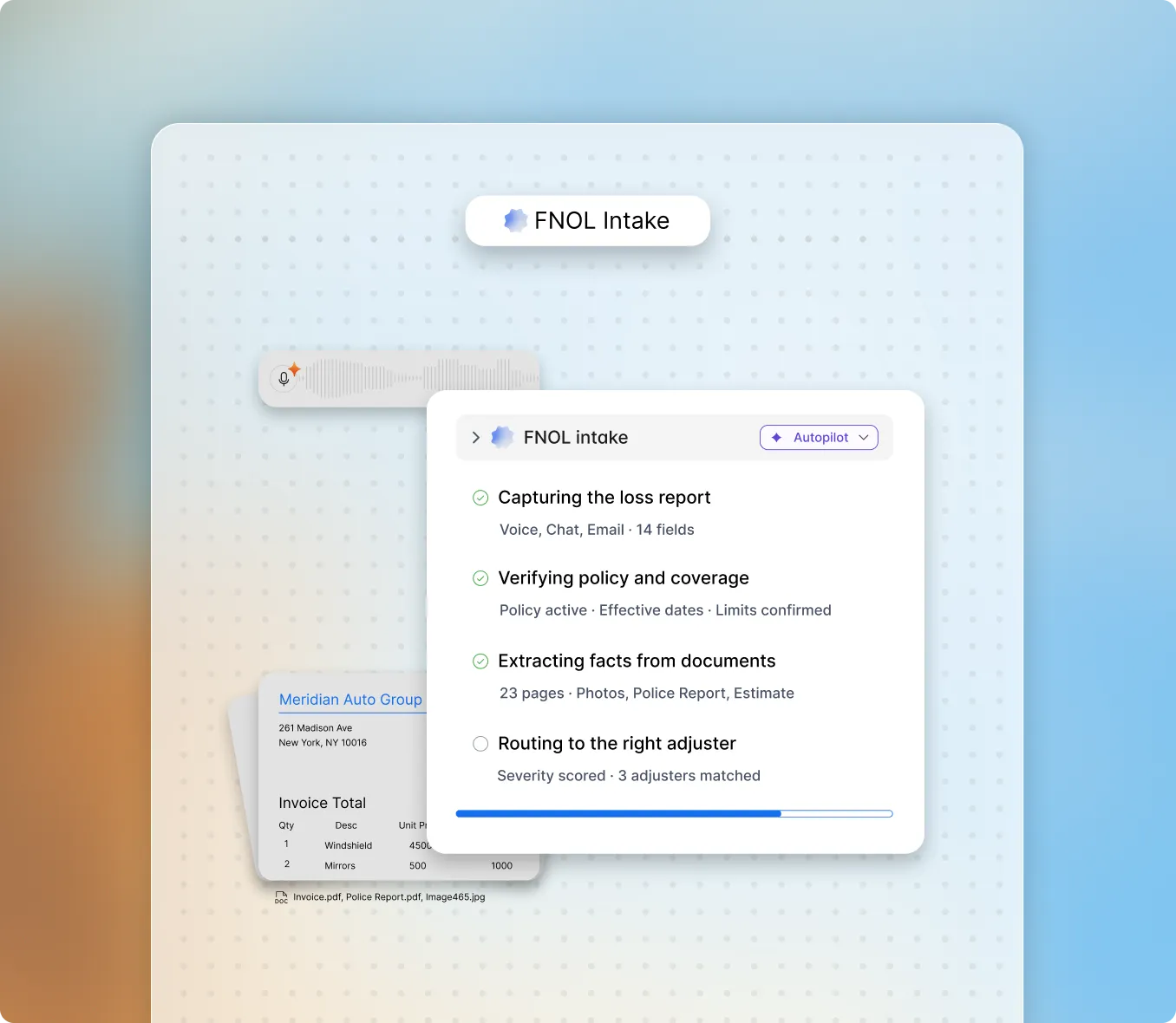
On the conversational side, external-facing agents handle policy servicing, COI issuance with compliance validation, structured claims intake, and broker servicing inquiries with system-level execution across voice, chat, and email. Far beyond just acknowledging requests, these agents take direct action within your systems. For adjusters and underwriters, an internal co-pilot instantly answers natural-language questions about coverage, exclusions, and limits hidden in dense policy documents. Each answer comes back structured and cited to the source clause. Your adjuster can verify the response against the document rather than trusting a confident paraphrase that can't be checked.
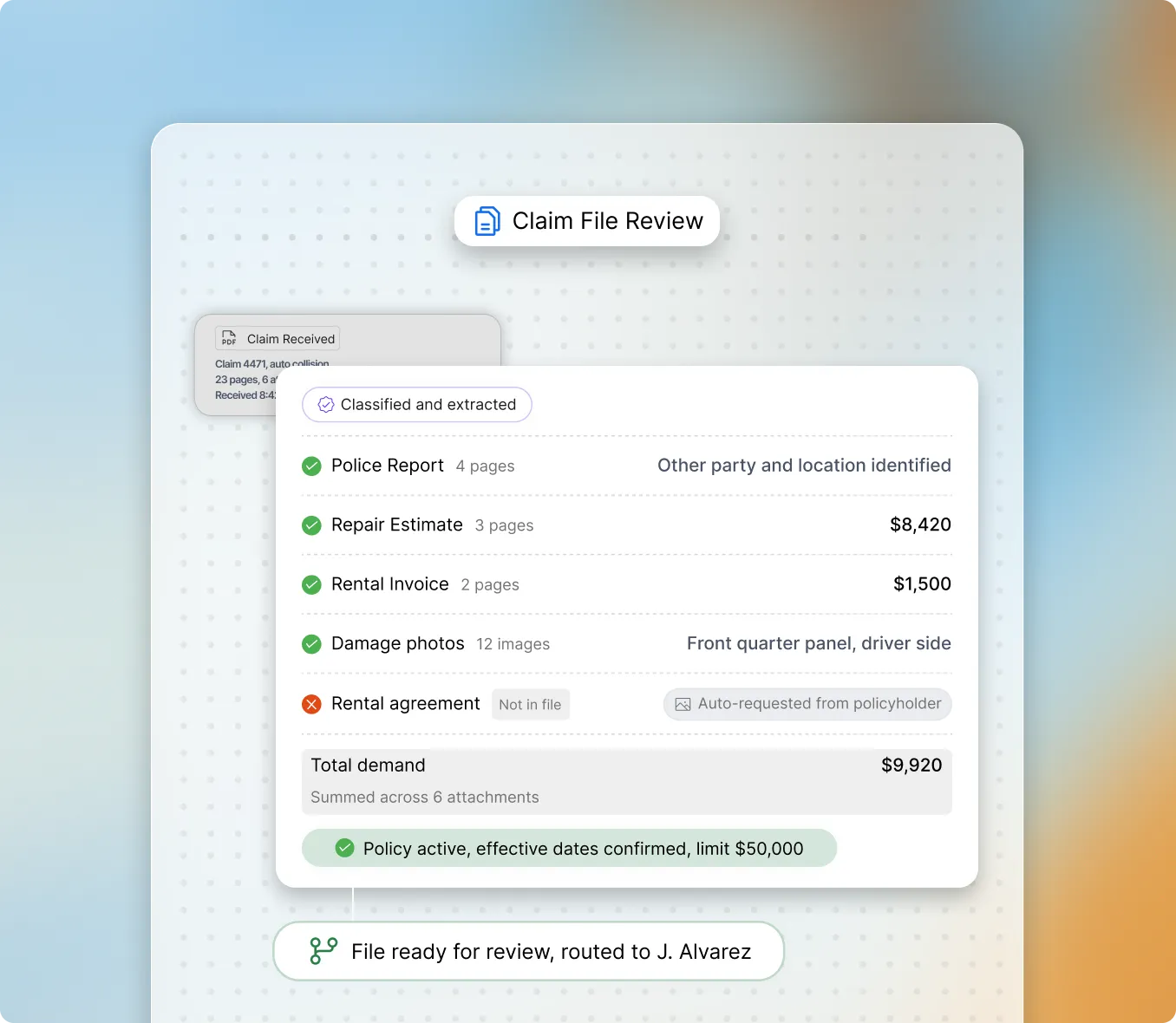
The back-office layer clearly separates leading providers from the rest. Agents classify and tag incoming email and document packets, extract structured data, and flag time-sensitive items on arrival. One U.S. carrier uses Notch to prioritize time-demand letters, pulling deadlines and risk indicators so high-liability cases escalate the moment they land.
Production Results that Matter
The production numbers tell a specific story. Carriers running Notch see 70 to 73 percent autonomous resolution of eligible interactions and 6x faster median time-to-resolution versus a fully human baseline. An MGA automating submission triage across 10 P&C lines and 25 states measured 99 percent accuracy in structured extraction and rules-based processing, with more than 250 percent efficiency gains in intake operations. VPC deployments built for enterprise insurance requirements have gone live in as little as seven weeks, with carriers reporting 200 percent ROI within twelve months and payback landing between months four and eight. Across all deployments, the platform has processed more than 20 million interactions and holds a 4.87 out of 5 policyholder CSAT.
Key Capabilities Required for Complex Claims
A true claims platform goes far beyond basic containment by orchestrating complex, multi-party workflows. It validates policy coverage with exact clause citations and enforces strict explainability for regulatory compliance. These core capabilities resolve stuck claims, shrink exception backlogs, and provide auditable decision trails.
Background Orchestration & Third-Party Coordination
A complex claim moves through a TPA, pulls in external data, sometimes touches a reinsurer, and lands on more than one adjuster's desk. System logic must track state across handoffs, flag exceptions instantly, and learn from edge cases instead of crashing. ADAM does this by reading interactions, watching for escalation patterns, and helping build new agents or workflow improvements, getting better over time. Higher volume expands automated processing and shrinks exceptions. That compounding effect is different from a static rules engine that needs a developer every time a new edge case shows up.
Deep Policy Document & Coverage Validation
Ask adjusters where the real difficulty lives in a complex file. The answer is the policy: endorsements stacked over several renewal cycles, exclusions written for a different scenario, and coverage triggers buried three schedules deep in a document nobody has read in years. In one deployment, an account manager can ask a plain-language question like whether a specific exposure is covered, whether a limit changed from the prior policy version, or whether a required endorsement is missing, and get back a source-linked answer instead of a summary to trust blindly. The agent does not just retrieve text: it provides source-linked answers and decision support so the team can validate the response and understand where it came from. By grounding every answer in direct document citations, Notch gives adjusters defensible decision support, eliminating the severe compliance risks of untraceable AI outputs.
Strict Explainability vs. Probabilistic Guesses
This is the feature most vendors hope you will not ask about during the demo. Twenty-five states and Washington D.C. have adopted the NAIC AI Model Bulletin, which requires documented governance and audit trails across the full claims lifecycle. New York's DFS has told insurers they need to prove their models do not proxy for protected classes, even through indirect correlations. A model that returns a confidence score with no decision trail cannot survive a market-conduct exam.
How to Choose the Right Platform for Complex Claims
Choosing the right platform for complex cases requires looking back at your files and spotting the gaps you need closed. Pull the last commercial liability file that took your team six weeks and three adjusters to close. Run every vendor on your shortlist against that file. You want answers to two questions.
Can the system read your policy language and hand an adjuster a cited, checkable answer about coverage, or does it return a confident summary nobody can trace? And when a regulator or a claimant asks how a determination was reached, does the system have that answer already built in, or does someone on your team have to reconstruct one from logs?
Test the document intake on a messy submission: scanned ACORDs, broker emails with attachments, a follow-up fax, handwritten notes, not-so-perfect photos, and voice notes. See whether the platform extracts and validates in one pass or just stores the attachment for someone to open later. Ask how the system handles a time-sensitive letter that arrives at 4 pm on a Friday with a ten-day deadline. If the answer involves a human noticing it in an inbox on Monday, you have found the gap the platform was supposed to close.
Can AI Handle Complex Insurance Claims End to End?
AI can handle large portions of a complex claim, but the phrase "end to end" needs honest qualification. The best platforms automate intake, document extraction, coverage validation, triage, and routing with production-grade accuracy. On a platform like Notch, a large portion of cases can be resolved through automation. The cases requiring legal judgment or negotiation stay with human adjusters. Cycle times drop at the handoff, where adjusters receive a complete, pre-built file instead of a raw inbox. Your team stops reading documents all morning and starts spending time on the two or three files that need their judgment. Real loss-ratio improvements come from this operational shift, while automated processing of simple claims barely moves the needle.
Where this breaks down: citation grounding is only as good as the source documents it's pointed at. A manuscript endorsement that was never digitized, or a coverage change made verbally and never filed, won't show up in a cited answer, and a team that stops double-checking because the tool is usually right is the actual failure mode to watch for.
Will bringing AI into complex claims replace adjusters?
Bringing AI into complex claims does not eliminate the adjuster role, but it changes what fills their day. AI delivers the highest value on complex claims with legal exposure, contested liability, or six-figure reserves, i.e., the exact files you won't hand down to pure automation. What shifts is the grunt work before any decision: reading forty pages of policy language, chasing a missing document, reconciling three data sources before an assessment can even start. In mature deployments, adjusters spend more time negotiating and investigating, and far less on data entry. Headcount plans built around "AI replaces X adjusters" tend to disappoint. Plans built around "each adjuster now closes more files without burning out" tend to hold up.
Can an AI claims platform work with our existing legacy systems, or do we need to replace our core platform first?
You don't need to replace your core platform to bring AI into claims. Notch connects directly to the systems you already run, including PAS, CRM, and systems of record. Its claims agents are built on top of Guidewire and Duck Creek rather than around them. Platforms that demand a core-system overhaul first force carriers to solve the wrong problem in the wrong order. In practice, deployment starts by wiring the agent into one high-friction workflow. First notice of loss or document intake are common starting points, with most first agents live in four to six weeks and each workflow after that deploying faster since the integration work is already done.
Conclusion
The carriers pulling ahead in 2026 are not the ones with the highest containment rate on their chatbot dashboard. They are the ones who pointed AI at the claims that were breaking their operations: the multi-party liability file, the endorsement stack with three layers of manuscript wording, and the time-demand letter that needed flagging the hour it arrived instead of the week after. These differences matter more than feature comparison, vendor scorecards, and number of demos requested.
If you have already run a pilot or deployed a first-generation tool, you know the gaps. The easy claims got easier. The hard ones stayed hard. Adjusters still waste mornings wading through documents rather than making decisions. When catastrophe season hits, backlogs spike because legacy platforms fail to absorb operational complexity at scale.
Run your evaluation against your hardest files, not your easiest ones. Bring the claim that took six weeks and three adjusters. If the vendor cannot show you how their system would have handled the coverage question buried in the endorsement, flagged the subrogation opportunity, and escalated the deadline nobody caught, you have your answer. Book a demo with Notch and bring those files with you.