
AI Document Ingestion Capabilities That Work for Insurance Operations
.png)
Elool Jacoby

Elool Jacoby
Elool Jacoby is the co-founder and CPO at Notch.cx, an autonomous AI platform that uses agentic architecture to resolve customer inquiries and complex workflows end-to-end.
Subscribe to updates
Receive the latest content and invites to your inbox, unsubscribe anytime.


A broker submits a new business opportunity the way brokers always have: an ACORD form here, a scanned loss run there, a follow-up email with two more attachments, and maybe a voicemail clarifying a detail nobody wrote down. Somewhere in that pile is everything an underwriter needs. The real question is whether reading a document leads to a clear decision or simply a better-organized file.
That distinction is what separates real AI document ingestion from a scanner with a marketing budget. In this article, we outline what ingestion needs to cover in insurance operations, where the case for it is proven in production, why traditional document processing keeps breaking under real submission volume, and what it looks like when ingestion connects all the way through to a decision instead of stopping at extraction.
What Is AI Document Ingestion for Insurance Operations?
AI document ingestion is the process of taking unstructured inputs, like PDFs, scanned forms, emails, faxes, and phone calls, then turning them into structured, validated data a downstream system can act on. In insurance, that definition carries three requirements a generic document tool doesn’t meet: security, privacy, and deterministic accuracy. A document ingestion system that can't guarantee all three isn't ready for a regulated workflow, regardless of how well it reads a PDF.
This is the exact problem Notch was built to solve. Insurance submissions don't arrive as one tidy file. They arrive as ACORDs, broker emails, scanned documents, faxes, and phone calls, often for the same risk, spread across various formats that need a human to assemble them into one piece. Unifying all of that into one structured record, with every field traceable back to its source, is the starting point for the insurance case outcome. The clearest proof of what that looks like in production comes from a Notch deployment for one fast-growing MGA: submissions across 10 P&C lines and 25 states, unified into a single workflow that reached 99% accuracy in structured extraction and rules-based processing, with more than 250% efficiency gains in intake operations.
Why Traditional Document Processing Breaks in Regulated Operations
Traditional document processing breaks when having to make sense out of fragmented information. OCR reads text. RPA moves fields between systems. Neither one understands what a document means for a specific policy, claim, or applicant. When the volume surges, the traditional processing collapses.
A handwritten note on page seven of a multi-page packet breaks a rigid template matcher. A mid-claim medical record that arrives out of sequence breaks a system that expects documents in a fixed order. And even when extraction works, it often stops there, leaving structured data sitting in a queue for a human to interpret, validate, and route. High accuracy figures look impressive in a vendor demo and mean very little if a person still has to act on every field the system pulls out. The traditional model was built to read documents faster. It was never built to move a case forward.
What AI Document Ingestion Covers
Real ingestion is a sequence of connected capabilities, not a single extraction step. The right order starts with intake and classification, goes through layout parsing, data extraction, and validation, and loops in a human where needed.
Intake and Classification
Every incoming file, regardless of format or channel, needs to be classified correctly first: an ACORD form, a broker email, a scanned loss run, a supplemental application. Notch classifies mixed-format submission packets into one unified intake channel, so a broker's five-attachment email and a single scanned PDF both enter the same structured pipeline instead of requiring separate handling logic for each format.
High-Precision Layout Parsing
Real documents are messy. Multi-page packages mix document types, tables sit next to free text, and the relevant details get buried on page seven of a ten-page file. Layout parsing has to hold up against that, instead of assuming every document follows the same clean template.
Entity Extraction and Structured Data Output
Once a document is parsed, entities and exposures get extracted in a single pass rather than requiring multiple passes per document type. For an insurance submission, that means business details, locations, coverage requests, limits, class codes, and prior policy information all get pulled out and structured at once, feeding directly into the systems that need them instead of sitting in a raw text dump someone has to parse manually.
Validation, Gap Detection, and Source Linking
Extraction alone doesn't tell you whether a submission is complete. Deterministic rule validation checks the structured data against the requirements. When something is missing or inconsistent, the flag doesn't just say information is missing. It links back to the specific document, email, or field that triggered the concern, so a reviewer won’t guess where to look.
Routing Based on Business Rules and Priority
Once a submission is validated, it needs to be routed somewhere specific. Routing applies appetite, priority, completeness, state, and line-of-business rules to determine whether a case moves forward automatically, gets flagged for clarification, or lands in a particular underwriting queue, rather than dumping every submission into one generic inbox regardless of what it actually needs.
Human-in-the-Loop Validation
Some cases need a person, and the system's job is making sure that person opens a ready file with the specific concerns identified. This same capability is covered in more depth in the governance section below, because in a regulated industry, human review isn't an edge case handler; it's a structural requirement.
How Notch's Agent Layer Differs From Raw OCR/IDP Engines
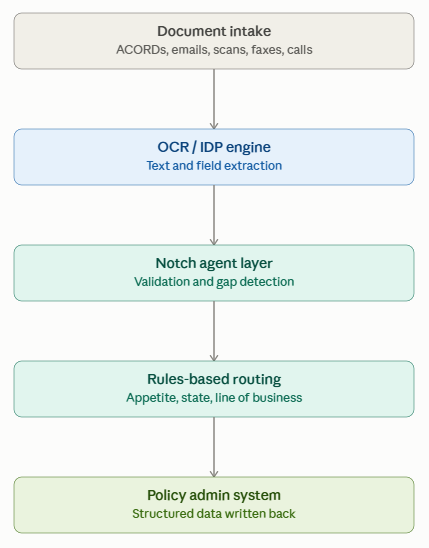
Reading a document and acting on it are two different jobs, and most vendors only do the first one. The diagram above shows where that split actually happens: everything up through OCR and IDP extraction is the vendor layer most document tools stop at, and everything after is where Notch's agent layer picks up.
Cross-Document Reconciliation
A submission package rarely lives in one file. Notch reconciles entities across ACORDs, broker notes, and attachments into one structured submission, rather than treating each document as a standalone artifact. If a broker email states a coverage limit of $2 million while the accompanying ACORD form lists $1.5 million for the same location, Notch flags that inconsistency, pointing to both source documents, instead of keeping two disconnected data points in two disconnected records that nobody cross-checks until a claim exposes the gap.
Context-Aware Extraction vs. Template Matching
Template matching assumes every document looks like the last one. Context-aware extraction understands what a field means for the specific policy and applicant, which is the difference between an AI that reads a FNOL form and an AI that reads a FNOL form and knows what it means for this claim, this coverage, this jurisdiction.
From Extraction to Execution
The layer below, the OCR and IDP engines, turns a scanned page into text and fields. That's a necessary step, but not the finish line. Notch is the layer that acts on that output: flagging gaps, applying underwriting or claims rules, routing the file to the right queue, and writing structured data back into the PAS. Extraction without that execution layer is expensive data capture with a longer handoff chain attached.
What Security and Governance Capabilities Does AI Document Ingestion Require in Regulated Industries?
Ingestion in a regulated industry isn't just a technical capability. It's a governance requirement, and it needs to be built in from the start rather than retrofitted after an audit finds a gap.
Data Sovereignty and Isolation
Customer and claims data needs to stay within a defined, controllable boundary. Notch supports data-zone selection, including all-US deployment, so an institution can confirm exactly where its data lives rather than accepting a vague assurance about "secure infrastructure" somewhere unspecified.
Immutable Audit Logging
Every document processed needs a record that can't be altered. That includes the audio, too. Recordings and transcripts from voice-based intake follow the same retention and deletion rules as any other claim documentation. A phone-based FNOL report is held to the same audit standard as a scanned form.
Role-Based Access Control
Not everyone on a claims or underwriting team needs to see every field. Field-level RBAC for carriers running Guidewire or similar systems means sensitive PII stays visible only to roles with explicit access, rather than being exposed to anyone with general system permissions.
How Does AI Document Ingestion Support Regulatory Compliance?
Compliance in document ingestion isn't a separate checklist bolted onto extraction. This system applies specific core capabilities across every step. It combines deterministic verification, source traceability, and immutable audit logs to ensure complete visibility. When judgment is required, low-confidence results route directly to human review, while strict data boundaries maintain residency control.
Notch ties this together through a five-layer compliance architecture:
That architecture sits underneath certifications including SOC 2 Type 2, ISO 27001, ISO 42001, HIPAA, GDPR, CCPA, and PCI. These are the baseline expectations for any platform operating across insurance, healthcare-adjacent, and financial data.
Document Ingestion Across Insurance Workflows
Document ingestion is the first step in almost every insurance workflow. Since it’s a regulated industry, this step follows a strict order before processing the claim accordingly:
Claims Intake and FNOL Document Packets
A FNOL packet often includes time-sensitive material: a time-demand letter with a hard deadline, medical records signaling injury severity, or documentation pointing toward a high-liability claim. Picture a time-demand letter arriving inside a larger FNOL packet with a 30-day response deadline buried on page four. The system must instantly extract deadlines and flag high-liability demands the moment a packet arrives. Routing it to a senior adjuster takes minutes, preventing the claim from losing critical response time in a routine queue.
Underwriting Submissions and Broker Emails
This is the exact scenario the MGA deployment referenced above solved in production: submissions across 10 P&C lines and 25 states, arriving through ACORDs, broker emails, scanned documents, attachments, faxes, and phone call inputs, unified into one structured workflow that caught gaps and inconsistencies before they became a delay in the underwriting process rather than after.
Policy Servicing and Endorsement Processing
Endorsement requests, address changes, and coverage adjustments all arrive as documents too, often with the same format chaos as new submissions. The same ingestion pipeline structuring new business submissions must handle mid-policy change requests just as reliably. It needs to confirm a change is permissible under existing policy terms before processing, rather than treating servicing documents as a lower priority.
What Happens After Ingestion: Connecting Documents to Decisions
Ingestion that stops at structured data hasn't finished the job. The real value shows up when that structured data triggers a decision: appetite logic, state-specific requirements, and underwriting rules applied to route clean data directly into the PAS, rather than generating an export someone has to act on manually. That's the handoff the diagram above traces from OCR and IDP output, through Notch's agent layer, into the policy admin system.
What Is the Difference Between IDP and OCR?
OCR reads characters off a page and converts them to text. It answers the question "what does this document say?" Take a scanned loss run: OCR alone returns a wall of text with dates, dollar figures, and claim descriptions all flattened into an unstructured block, still requiring a human to find and interpret each relevant field. Run that loss run through IDP and Notch's agent layer, and it instantly becomes structured data. It extracts prior claim counts, total incurred costs, and loss dates, mapping them directly to underwriter risk categories while flagging any missing gaps. OCR gives you text. IDP gives you structured, validated data ready for a decision.
The gap between the two is the difference between digitizing a filing cabinet and actually automating the workflow that filing cabinet used to support.
Can AI Process Insurance Documents With Multiple Formats?
Yes, and this is table stakes for any system built for real insurance operations rather than a clean demo dataset. A single risk submission spans ACORDs, broker emails, scanned documents, attachments, faxes, and phone calls, and a working ingestion system needs to unify them into one structured record rather than requiring separate handling for each format. The MGA case covered above is the direct proof: 10 P&C lines, 25 states, and every one of those input formats arriving simultaneously, unified into a single workflow that fed clean data straight into the policy administration system.
Conclusion
Reading a document was never the hard part for an automated insurance workflow platform like Notch. Turning what a document says into a decision a claims or underwriting team can trust, without a human manually bridging the gap between extraction and action, is where document ingestion actually earns its place in insurance operations.
The capabilities that matter aren't a single extraction score. The pipeline relies on key capabilities: classification, layout parsing, entity extraction, gap detection with source-linked flags, rules-based routing, and human review where needed. Every step is built on a security and governance foundation that holds up under strict regulatory scrutiny.
Ingestion isn't the finish line. Execution, the moment structured data triggers an actual routing decision, an actual flag, an actual entry into the PAS, is where the work either gets done or doesn't. That's the gap Notch's agent layer closes, and it's the same gap that turned one MGA's fragmented, multi-channel intake process into 99% accuracy and more than 250% efficiency gains. This happened not because the documents got read faster, but because reading them finally connected to something that moved the case forward.
Key Takeaways
- AI document ingestion isn't about reading documents faster. It's about turning unstructured submissions, ACORDs, broker emails, scans, faxes, and calls into structured data that triggers an actual decision.
- OCR and IDP turn a page into text and fields; the agent layer on top of that has to flag gaps, apply business rules, route the file, and write structured data back into the PAS.
- A flag that says "information is missing" is less useful than one that links back to the specific document, email, or field that triggered it.
- Data sovereignty, immutable audit logging, role-based access control, and jurisdiction-aware rules are structural requirements for any system handling regulated documents.
Got Questions? We’ve Got Answers
What ROI Should You Expect From AI Document Ingestion?
ROI from AI document ingestion typically shows up first in FNOL cycle time and adjuster capacity, then in loss adjustment expense over the following couple of quarters as the deployment matures. The three numbers worth tracking are minutes from document arrival to claim setup, the percentage of documents that flow through without a human touch, and adjuster hours redirected from data entry back to actual claim work.
Can AI Document Ingestion Handle Handwritten Notes and Poor-Quality Scans?
Handwritten notes and poor-quality scans are where AI document ingestion earns its place over plain OCR, not a weakness it has to work around. Modern platforms pair handwriting recognition with confidence scoring, so a smudged supplement or a hand-filled FNOL form gets read where the model is confident and routed to a human where it isn't, instead of forcing bad data into the claims system either way.
Will AI Document Ingestion Replace Adjusters or Underwriters?
AI document ingestion doesn't replace adjusters or underwriters; it removes the document prep work that keeps them from doing the job they were hired for. Coverage analysis, reserve setting, settlement negotiation, and complex liability calls still need a person. What changes is the ratio: an adjuster who used to spend half a day moving data between systems gets that time back for claim files instead, which is why carriers running this well end up with people handling more claims at higher quality rather than smaller teams doing the same volume.
How Does Document Ingestion Actually Integrate With Guidewire or Duck Creek?
Document ingestion integrating with Guidewire or Duck Creek can mean anything from a nightly batch file drop to real-time API integration with data flowing both directions, and the two aren't remotely equivalent. The question worth asking a vendor isn't whether they connect to your system; it's whether the integration is certified for the specific version you're running, whether claim creation happens the moment a document arrives or on a schedule, and whether extracted data gets validated against your live policy record during extraction. Anything short of that recreates the exact data quality problem ingestion was supposed to fix.
How Is Notch's Ingestion Layer Different From a Standalone IDP Vendor?
Notch treats document ingestion as one connected step inside the claims or underwriting workflow rather than a standalone extraction layer that hands its output to something else. Time-demand detection runs at the semantic level, reading the full text of incoming legal correspondence for deadline patterns instead of scanning for trigger words, and the same orchestration layer that extracts a field also validates it, routes it, and writes it into the PAS, producing one audit trail from arrival to adjuster assignment instead of several disconnected ones. That architecture is why Notch's document processing reaches up to 70% resolution on cases before a human ever gets involved, not because the extraction model reads faster, but because reading finally connects all the way through to an actual decision.
.svg)


.png)
.png)
.png)